
Commercial Façade Cleaning in Dallas–Fort Worth
Commercial property managers, facility directors, and building owners managing multi-story EIFS, stucco, masonry, glass-and-steel, and metal panel facades in DFW
What You Are Dealing With
The problem with most commercial facade cleaning bids is not the price — it is the method. Most vendors apply the same PSI setting to every surface on the building. EIFS (Exterior Insulation and Finish System) and synthetic stucco require soft wash: low pressure, surfactant-based chemistry, extended dwell time. Apply high-pressure water to EIFS and you force moisture behind the finish coat, saturating the foam substrate and triggering delamination, cracking, and warranty voids — damage that costs more to repair than the facade cleaning quote. Painted brick and architectural concrete can handle a pressure rinse, but require pH-neutral chemistry or you bleach the pigment and accelerate surface carbonation. Glass curtain wall and metal panel cladding need deionized water only — any detergent residue creates streaking and mineral haze that requires a second visit to correct. On a mixed-material building with three or four surface systems on the same elevation — a common configuration in DFW Class A commercial construction — a vendor using one method is either undertreating most of the building or damaging part of it. Surface chemistry is not a variable. It is a requirement.
How BolAero Solves This
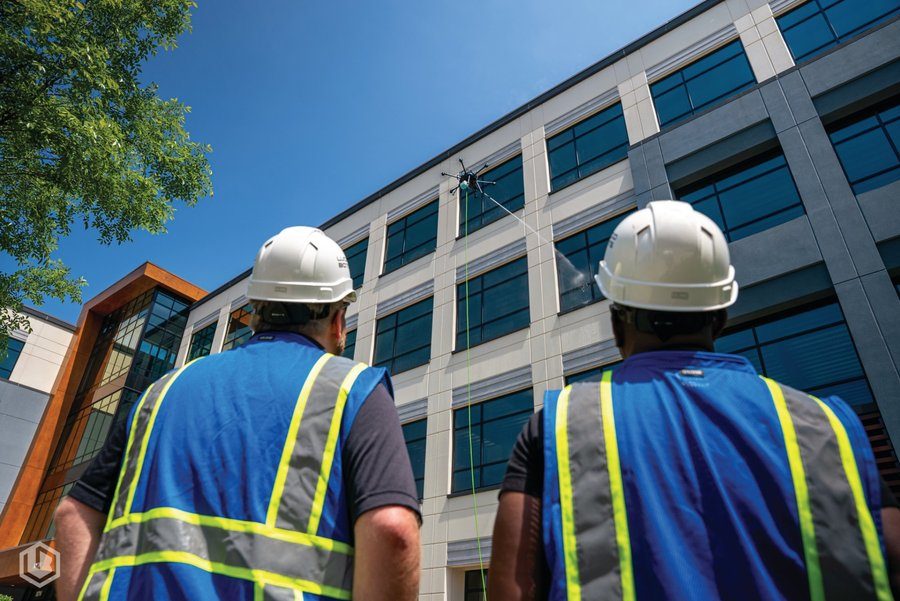
BolAero façade cleaning begins with a surface assessment, not a pressure washer. Before mobilization, the operator identifies every surface system on the building envelope — EIFS, stucco, painted brick, architectural concrete, glass curtain wall, metal panel, cladding — and prepares the appropriate chemistry for each. EIFS and synthetic stucco receive soft wash: low-pressure delivery, surfactant solution matched to contamination type, dwell time calibrated to soiling level. Painted brick and concrete receive pressure rinse at appropriate PSI with pH-neutral or mildly alkaline chemistry, no bleaching agents. Glass and metal panel receive deionized water rinse only — mineral-free, residue-free, spot-free result. When multiple surface types are present on the same elevation, each section is treated with its specific method in a single visit. One mobilization. One Proof-of-Clean Report covering the full building. The drone operates at any elevation on any surface — no scaffolding, no boom lift, no access equipment — which means the per-surface method selection is driven entirely by chemistry, not by access cost or convenience.
Speed
Most mid-rise commercial facades complete in one to two days. The drone operates at any elevation without scaffolding setup or teardown. For buildings with multiple surface systems, the operator pre-loads chemistry for each mix before mobilization — arriving on-site ready to work each section in sequence without re-mobilizing between zones. Post-clean documentation is delivered within 48 hours of job completion.
What This Typically Costs
Commercial façade cleaning runs $1,500 to $8,000 for mid-rise commercial buildings in DFW depending on surface system complexity, building height, and contamination severity. Mixed-material buildings — where three or four surface systems are present on the same facade — run toward the upper range because each system requires separate chemistry preparation and distinct application passes. Traditional scaffolding-based facade cleaning of the same building typically costs three to four times more before chemistry considerations. Multi-building portfolios and annual maintenance programs reduce per-visit cost and simplify facilities planning.
Site Disruption Plan
Site Disruption Plan
Every BolAero job includes a written disruption plan before work begins. This is how we keep your property operating normally during cleaning.
Advance Notification
We provide tenant and resident notification templates before every job. Your management team stays ahead of questions.
Parking Management
Which areas are restricted, for how long, and what alternatives are available. Documented in writing before the crew arrives.
Pedestrian Routing
Active cleaning zones are marked. Pedestrian paths around work areas are identified during the pre-job survey.
Work Window Options
After-hours, weekend, and low-traffic period scheduling available. We work around your building operations, not the other way around.
Noise Expectations
Drone and pump noise levels communicated in advance. Significantly quieter than scaffolding assembly and gas-powered equipment.
Water & Environmental Compliance
Water & Environmental Compliance
Commercial exterior cleaning involves water and chemicals. We manage both responsibly and document our approach for your records.
Biodegradable Chemistry
All cleaning chemicals are biodegradable with Safety Data Sheets available on request. We select chemistry rated for each surface type.
Runoff Management
Water containment and diversion measures deployed on every job. Runoff is managed, not ignored.
Volume Estimates
Approximate water usage provided during the quote process so you can plan for utility impact and drainage.
City Stormwater Compliance
Our water management approach is designed to comply with local city stormwater regulations wherever we operate. Documentation provided.
Building Types for Commercial Façade Cleaning
Class A office towers, mixed-use commercial developments, hotels and hospitality properties, hospitals and healthcare facilities, government and municipal buildings, mid-rise apartment complexes with EIFS or stucco exteriors, retail centers with architectural cladding, churches with masonry or stucco facades, any multi-story commercial building with mixed surface systems.
Questions About Commercial Façade Cleaning
What is the difference between façade cleaning and pressure washing?
Pressure washing describes the delivery method — high-pressure water. Façade cleaning describes the full scope of exterior building surface restoration, which may use pressure washing on some surfaces and soft wash or deionized water rinse on others. A proper façade cleaning project for a mixed-material commercial building uses multiple methods in the same visit. The surface chemistry determines the approach, not a single PSI setting applied to everything.
Can EIFS be cleaned without damage?
Yes — but only with soft wash, not pressure wash. EIFS is foam-backed with a thin finish coat. High-pressure water penetrates the finish layer and traps moisture in the foam substrate, causing delamination, cracking, and manufacturer warranty voids. BolAero uses soft wash chemistry on all EIFS surfaces, matching surfactant concentration and dwell time to the contamination level. No pressure contact with the surface.
What about stucco — can that be pressure washed?
Traditional three-coat and synthetic stucco both require soft wash, not pressure wash. Like EIFS, stucco is porous and susceptible to water intrusion behind the finish layer. The correct method is surfactant application, calibrated dwell time, and low-pressure rinse. For heavily soiled stucco — accumulated exhaust film, mold growth, algae — the dwell time on the chemistry does the work. Increasing water pressure on stucco forces contamination deeper and risks surface erosion.
How do you clean glass curtain wall without streaking?
Deionized water only — no detergents, no surfactants. DI water has no dissolved minerals, so it evaporates without leaving spots or residue film. The drone delivers a controlled DI rinse at the correct angle and flow rate for each glass panel. Metal panel cladding receives the same treatment. Any detergent application to glass or metal panel deposits a mineral or surfactant film that creates more maintenance work than it addresses.
How often should commercial facades be cleaned in DFW?
Annual cleaning is the minimum for most Class A commercial buildings in the DFW Metroplex. The regional atmosphere deposits highway exhaust particulate, construction dust, seasonal pollen, and post-storm organic material on building facades continuously. Annual cleaning prevents surface staining from setting permanently into porous materials. Stucco and brick exposed to the DFW summer heat cycle — contamination plus sustained high temperatures — bond organic staining into the surface in ways that require chemical treatment rather than routine cleaning if left for two or more years.
Do you provide documentation for warranty and insurance purposes?
Yes. Every façade cleaning project includes a Proof-of-Clean Report with before-and-after photos organized by building elevation and surface zone, a scope-completed checklist identifying each surface system and cleaning method applied, and a maintenance recommendation. This documentation supports roof and wall system warranty compliance, facilitates capital planning discussions, and provides a defensible maintenance record for property refinancing, sale due diligence, or insurance renewal.
Can you clean a building with multiple facade materials in one visit?
Yes. Mixed-material facades are standard in DFW Class A commercial construction — glass and EIFS, brick and metal panel, stucco and architectural concrete are all common combinations. BolAero pre-loads the required chemistry for each surface system before mobilization and works each section in sequence in a single visit. You receive one mobilization charge and a complete building result rather than separate vendor contracts for each surface type.
Ready to See What Drone Cleaning Can Do?
Call us or submit a request. We respond the same business day.